
- by admin
- Posted on April 14, 2026
- in Blog
IBM DataPower Best Practices for Stable Design
IBM DataPower Best Practices for Stable Design
IBM DataPower Best Practices for Stable DesignThis article is based on practical experience from a Middleware Consultant at Powersoft Technologies.
IBM DataPower is often presented as a highly reliable API gateway, and it is. But in practice, the difference between a setup that runs smoothly and one that wakes you up at 3 AM usually comes down to design decisions made early on, when the focus was simply to get things working.
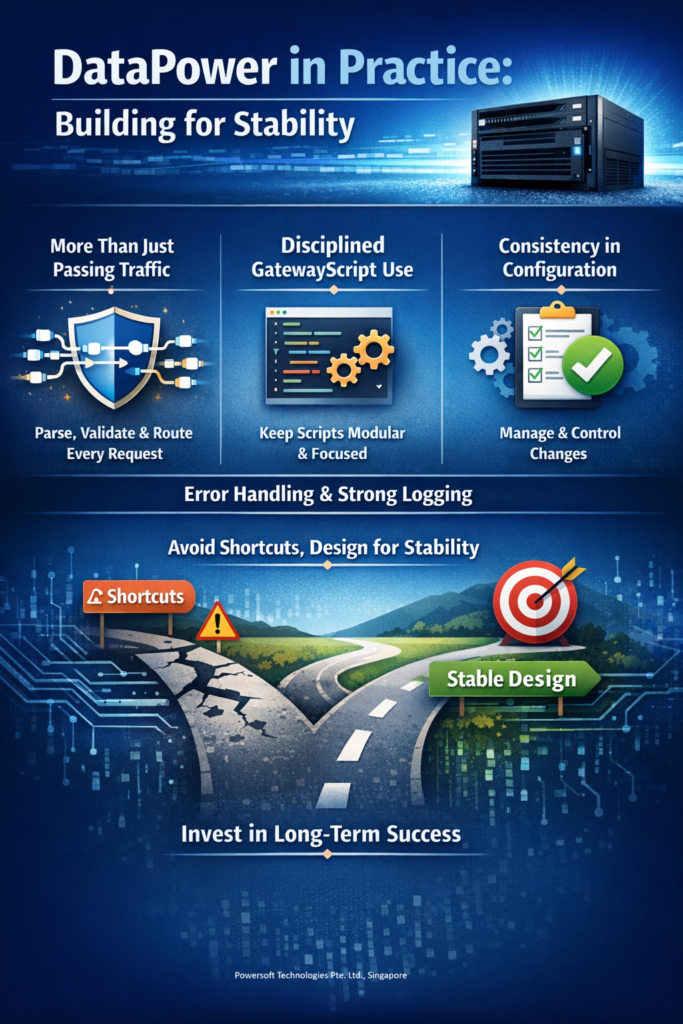
A common mistake is treating DataPower like it’s just forwarding traffic. I’ve seen this play out multiple times. It starts with a simple proxy during development, it passes UAT, goes live, and everything looks fine. A few months later, response times start creeping up and nobody is quite sure why. The reality is, DataPower is doing more than just passing requests. It is parsing messages, evaluating rules, validating headers, and managing connections on every call. If that isn’t accounted for upfront, troubleshooting later becomes unnecessarily difficult.
Gateway Script can also become a problem if not structured carefully. I once worked on a gateway where a single script handled routing, transformation, and error handling. During a production timeout issue, we spent hours just isolating where things were breaking. Splitting logic into smaller, focused scripts doesn’t just help with maintainability. It makes a real difference when you’re trying to fix something under pressure.
Error handling is another area where things can quickly get confusing. I’ve seen backends fail while the gateway still returns a 200 OK, and at the same time, genuine client errors get reduced to generic responses. In production, that lack of clarity makes diagnosis harder than it needs to be. You need clear signals: what failed, where it failed, and why. Default behaviour rarely gives you that.
Logging is similar. It often looks sufficient during testing, but gaps become obvious when something goes wrong in production. When a critical transaction fails, the questions come fast: Did the request reach the gateway? How was it routed? Where did it fail? Without correlation IDs and structured logging, you end up stitching together fragments from multiple systems.
Configuration drift is another issue that builds up over time. Small, manual changes like adjusting a timeout in UAT or tweaking routing during a production incident, start to accumulate. Months later, the same service behaves differently across environments, and no one is entirely sure why. Without proper checkpoints and change control, consistency becomes difficult to maintain.
The real challenge with DataPower isn’t learning how to use it. It is resisting the urge to take shortcuts when timelines are tight. Those decisions don’t always show their impact immediately, but they do surface later. And when they do, it’s usually in production. Designing for stability from the beginning makes a noticeable difference when systems are under load and expectations are high.
IBM DataPower continues to be a highly reliable and widely used API gateway in enterprise integration environments. In practice, its stability and performance depend largely on how it is designed, implemented, and governed from the beginning.
At Powersoft Technologies, we understand the difficulties you face in the real-world implementations:
- DataPower is more than just passing traffic
- GatewayScript flexibility requires discipline
- Configuration consistency is critical
At Powersoft Technologies, we apply these principles in real-world implementations to help ensure stable, well-governed, and scalable DataPower environments for enterprise integration needs.