
- by admin
- Posted on October 29, 2026
- in Blog
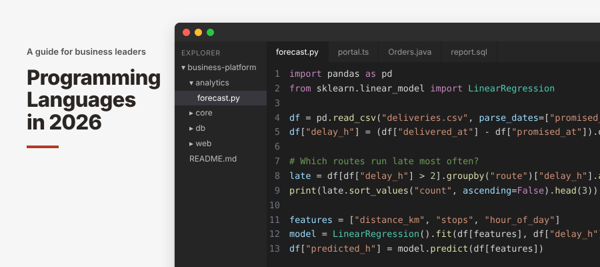
Python, JavaScript, Java or Go? Most businesses face this choice when they modernise a system, add AI or move to the cloud, and the answer affects development costs, hiring, performance and security for years.
The right language depends on the problem, the technical requirements and the skills available. The popularity rankings, meanwhile, don’t agree with each other.
According to GitHub’s 2025 Octoverse report, TypeScript became the most-used language on GitHub by contributor count in August 2025, yet recruiters still ask most often for Python, JavaScript, and Java. Rankings like these are a useful starting point, but they can’t tell you which language suits your systems. This guide explains how to read them, covers the 14 languages recruiters ask for most and what each is good for, and shares what we’ve learned helping clients make these decisions.
How Do We Measure Programming Language Demand?
No single ranking identifies the best or most in-demand language, because different reports measure different things:
- Recruiter demand: the skills employers say they need when hiring.
- Developer adoption: the languages developers report using at work.
- GitHub activity: contributions and project growth on GitHub.
- Search interest: how often people search for a language, which is what the TIOBE Index largely measures.
These measures often disagree. CoderPad and CodinGame’s 2025 State of Tech Hiring report found that 45.7% of surveyed recruiters wanted Python skills, 41.5% JavaScript, and 39.5% Java. The TIOBE Index, by contrast, ranks C second and leaves TypeScript out of its top 20 entirely.
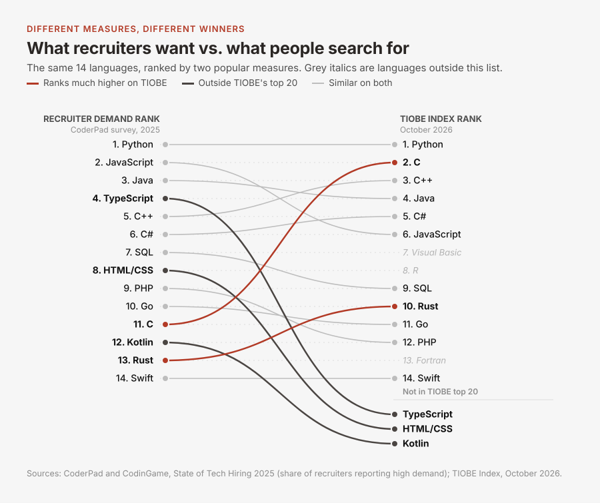
So it pays to look at several measures before reading too much into any one of them.
14 Programming Languages to Know in 2026
The 14 languages below are the ones recruiters requested most often in the CoderPad survey (Bash, used mainly for scripting, is left out). The table lists them in order of recruiter demand, with notes in each section where other measures tell a different story.
Language | Primary applications | Why businesses use it | Recruiter demand* |
Python | AI, machine learning, automation, data analysis | Extensive libraries and rapid development | 45.7% |
JavaScript | Websites, web applications, server-side development | Essential to interactive web experiences | 41.5% |
Java | Enterprise systems, APIs, financial applications | Mature ecosystem and reliable long-term support | 39.5% |
TypeScript | Large web applications, frontend and backend APIs | Static typing helps manage complex codebases | 27.9% |
C++ | Gaming, embedded systems, high-performance computing | Fine-grained control and performance | 24.4% |
C# | Enterprise applications, cloud services, .NET development | Strong tooling and Microsoft integration | 24.4% |
SQL | Databases, reporting, data analysis | Essential for querying relational data | 21.3% |
HTML/CSS | Web page structure and presentation | Foundation of every website | 17.4% |
PHP | Websites, content management, backend applications | Established web ecosystem and broad hosting support | 13.6% |
Go | Cloud services, networking, infrastructure | Efficient concurrency and simple deployment | 10.2% |
C | Embedded systems, firmware, operating systems | Runs close to hardware with minimal overhead | 10.0% |
Kotlin | Android applications, backend services | Modern features and Java interoperability | 6.9% |
Rust | Systems software, security-sensitive components | Memory safety with high performance | 5.1% |
Swift | iOS, macOS and Apple-platform applications | Native Apple software development | 3.4% |
*Share of about 1,500 recruiters in 143 countries reporting high demand for each language (CoderPad and CodinGame, State of Tech Hiring 2025). Respondents could choose several languages.
1. Python: A Leading Language for AI and Automation
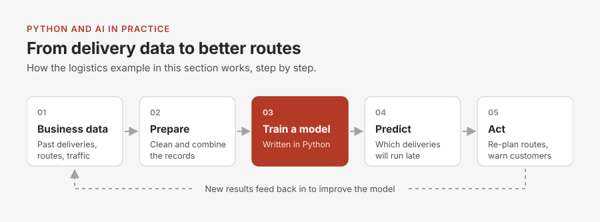
Python is known for readable syntax and a very large library ecosystem, including PyTorch, TensorFlow, and scikit-learn for machine learning. It is used for AI, data analysis, automation, and backend APIs. A logistics company, for instance, could use it to analyse historical delivery data, spot recurring delays and forecast better routes. GitHub found that Python accounted for nearly half of new AI-focused repositories, and it tops both the CoderPad survey and the TIOBE Index.
2. JavaScript: The Foundation of Interactive Web Applications
JavaScript makes websites interactive and, through Node.js, also runs on servers. Its ecosystem lets one team build both the interface and the backend of a web application, which helps explain why 41.5% of recruiters report demand for it. A typical use is a customer portal where clients submit requests, track progress and manage their accounts.
3. Java: A Strong Choice for Enterprise Software
Java has a long track record in large backend systems, transaction processing, and financial applications. Frameworks such as Spring and mature libraries for messaging and web services make it a common choice where reliability matters. Banks, for example, often run their core transaction processing in Java, connected to payment, customer and reporting systems. It is also one of the most frequent languages behind services connected through enterprise middleware.
4. TypeScript: Managing Complex Modern Applications
TypeScript adds static typing to JavaScript, helping teams catch errors before code runs. The benefit grows with the size of the project: when several developers work on the same application, it keeps shared code consistent and makes changes safer. It is the most-used language on GitHub and fourth in recruiter demand (27.9%), yet it does not appear in TIOBE’s top 20 at all.
5. C++: Performance-Critical Software
C++ gives detailed control over memory and system resources, which suits game engines, simulation, embedded systems, and trading infrastructure. That control brings greater responsibility for careful memory management. Engineering firms, for instance, use it for simulations that run heavy calculations under tight time limits.
6. C#: Enterprise Applications and the .NET Ecosystem
C# runs on Microsoft’s .NET platform and is used for web applications, APIs, desktop software, and cloud services. For organisations already invested in Microsoft technologies such as Azure, SQL Server, or Microsoft 365, it is often the lowest-friction option. An inventory or approvals app that has to plug into an existing Microsoft setup is a natural fit.
7. SQL: Essential for Working with Business Data
SQL is the standard language for retrieving and managing data in relational databases such as PostgreSQL, MySQL, Oracle, and SQL Server. Nearly every business application depends on it, so SQL skills are valuable whatever the main application language. Even a simple question such as “which products sold best last quarter?” is usually answered with an SQL query.
8. HTML and CSS: The Structure and Style of the Web
HTML defines the structure of web content and CSS its presentation. Strictly speaking they are not programming languages, but 17.4% of recruiters still list them as in demand, ahead of PHP and Go. Well-structured HTML also supports accessibility and search visibility.
9. PHP: Websites and Established Business Applications
PHP powers a large share of the web, including WordPress, and modern versions are much faster than the language’s reputation suggests. That reputation is often why working PHP applications get rebuilt when they don’t need to be.
We saw this recently with one of our clients. Their web application, written from scratch in PHP, needed to work reliably across different browsers and devices, and the first idea was to move it to a newer language. When we looked into it together, it became clear that the issues had nothing to do with the programming language itself. How an application looks and behaves in a browser or on a phone depends on its HTML, CSS and JavaScript, not on the language running on the server. Rewriting it in another language would have carried the same problems straight into the new system.
So they kept the technology and fixed the issues where they actually were. For most businesses in a similar position, that will do more than starting again. A rewrite makes sense when the current platform genuinely can’t do something you need, not because the language has gone out of fashion.
10. Go (Golang): Cloud Services and Infrastructure
HTML defines the structure of web content and CSS its presentation. Strictly speaking they are not programming languages, but 17.4% of recruiters st
Go was designed for simplicity, fast compilation, and concurrency, and widely used cloud tools such as Docker and Kubernetes are written in it. Because it compiles to a single binary, Go services are straightforward to deploy. It suits small background services, such as one that collects operational data from several cloud applications and serves it through an API.
ill list them as in demand, ahead of PHP and Go. Well-structured HTML also supports accessibility and search visibility.
11. C: The Language Underneath Everything Else
Operating systems, device drivers, databases, and even the Python runtime are largely written in C, and it ranks second in the October 2026 TIOBE Index. Businesses rarely build customer-facing software in C, but it remains essential wherever code runs close to hardware, such as the firmware that controls sensors and motors in manufacturing equipment.
12. Kotlin: Modern Android and Backend Development
Kotlin is Google’s preferred language for Android and is also used for backend services. Because it works seamlessly with Java, organisations can adopt it gradually alongside existing systems. A common pattern is an Android customer app in Kotlin that talks to existing Java backend APIs.
13. Rust: Performance with Stronger Memory-Safety Guarantees
Rust’s design prevents many common memory-safety errors before code runs, without sacrificing speed. Recruiter demand is still modest (5.1%), but it ranks tenth on TIOBE. Its benefits should be weighed against a steeper learning curve and a smaller pool of experienced developers.
14. Swift: Applications for Apple Devices
Swift is Apple’s language for iPhone, iPad, and Mac software. Businesses choose it when they need native performance or close integration with Apple’s ecosystem. Think of an iPhone app that lets clinic staff check appointments and notifications on the move.
Key Trends Shaping Programming Languages in 2026
AI is influencing technology choices
Python remains central to building AI capabilities, while JavaScript and TypeScript bring those capabilities into websites, dashboards, and business applications. A common pattern pairs a Python service for data and models with a TypeScript interface.
AI-assisted coding makes code quality more important
AI coding assistants can generate code, tests, and documentation, but their output still needs review. Strong type systems, automated tests, and clear interfaces help catch errors early, although no language on its own guarantees secure software or easy maintenance.
Integration matters as much as the language itself
Cloud platforms run almost any language, so most organisations end up with a mix: newer services, long-established enterprise systems, and databases. Once that happens, the hard problems shift from writing code to connecting it, with consistent security, data transformation, and monitoring across every service.
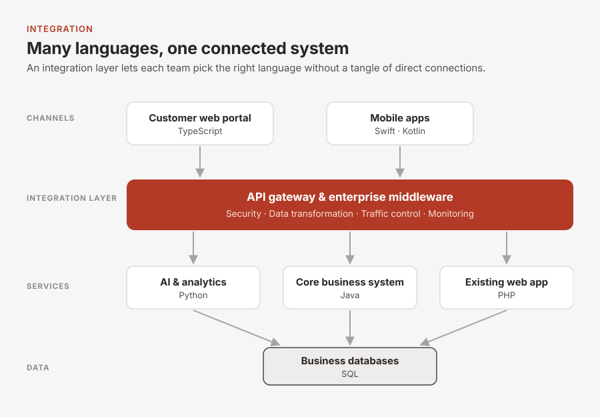
Integration layers such as API gateways and enterprise middleware solve this. They let a Python AI service, a Java core system, and a TypeScript portal communicate through governed, secure APIs, so each team can use the best language for its part without creating a fragile web of point-to-point connections.
How Should Businesses Choose the Right Programming Language?
Popularity is a useful signal, but the right choice comes from your own requirements. Work through three questions in order:
- What is the business objective? A customer-facing website, mobile app, AI capability, integration, or data-processing project each points to different languages.
- Does it fit your environment? Check performance, security, and scalability needs, compatibility with existing databases and platforms, and whether you can hire or train the developers.
- What will it cost to own? Include development, infrastructure, security updates, and long-term support. For larger projects, a small proof of concept can test the riskiest assumptions first.
Many systems end up using several languages, for example Python for data processing, TypeScript for the interface and Java for core services. That works well, as long as each part has a clear job and someone has planned how they connect.
How Powersoft Technologies Can Help
Choosing languages is the first step. Making a multi-language system work reliably depends on how its parts are connected, secured, and monitored.
Powersoft Technologies specialises in enterprise middleware and integration, including IBM DataPower, IBM API Connect, and Oracle SOA Suite. These platforms let organisations expose services written in any language as secure, managed APIs. Explore our middleware solutions.
Frequently Asked Questions
Which programming language is best for AI in 2026?
Python, because of its mature machine-learning libraries and frameworks. The final choice still depends on the use case, the skills available, and how the AI capability will connect to existing systems.
Which languages are most useful for enterprise applications?
Java and C# dominate enterprise backends, with JavaScript or TypeScript for web interfaces and SQL for data. Integration technologies tie them together.
Is TypeScript replacing JavaScript?
Not entirely. TypeScript overtook JavaScript on GitHub in 2025, but it compiles to JavaScript, and recruiters still ask for JavaScript more often (41.5% against 27.9%).
What Businesses should consider
No language is best for everything. Start from what your business needs, check how a new system will connect to the ones you already run, and treat the rankings as background rather than the deciding vote.
If you are planning a software project, application modernisation, or enterprise integration, contact Powersoft Technologies to discuss the most practical approach. Often that means extending what you have rather than replacing it.